
Introduction
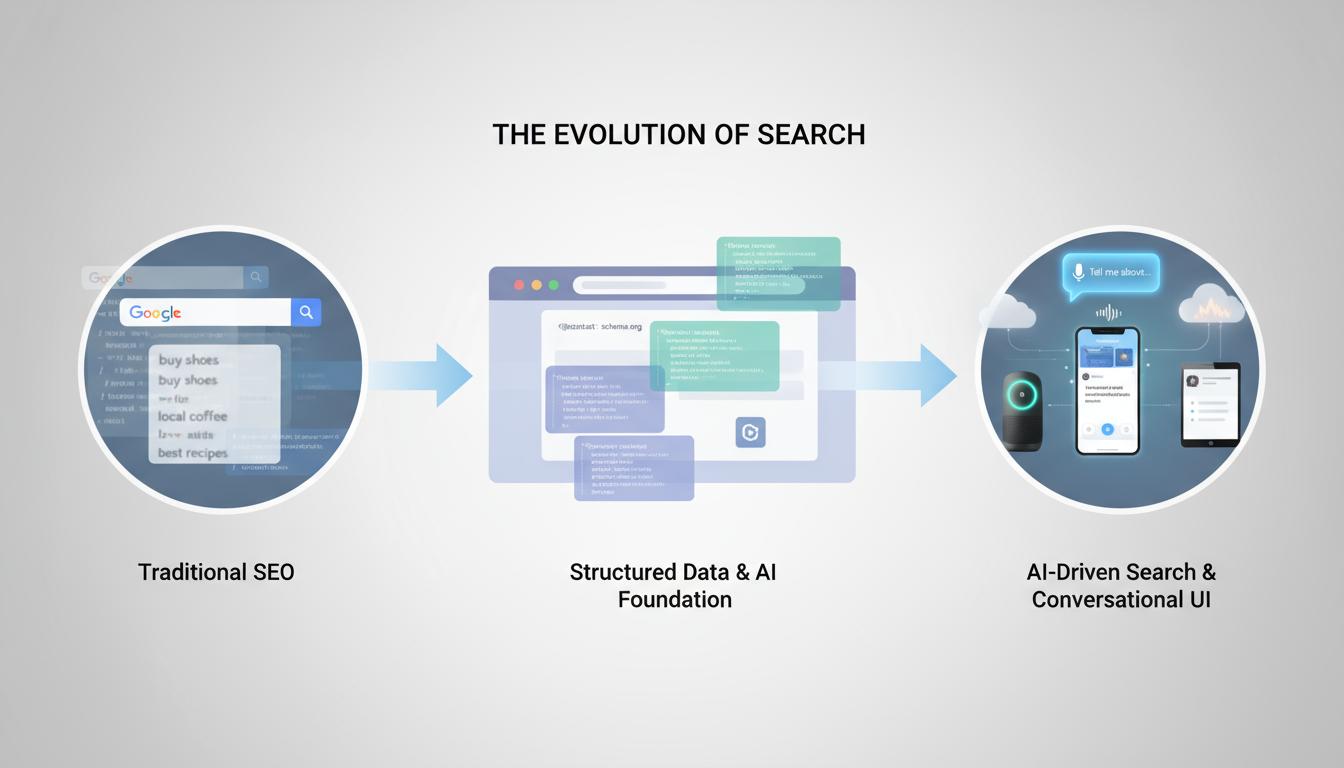
Search is no longer limited to typing keywords into Google and clicking a website.
Today, people search in different ways. They may type a short query into Google, ask a complete question, use voice search, or ask an AI tool to recommend a company or explain a topic.
This change has created three important areas of search optimization: SEO, AEO, and GEO.
But what do these terms actually mean? Is SEO becoming less important? Should a business focus on AEO or GEO? And do you really need all three?
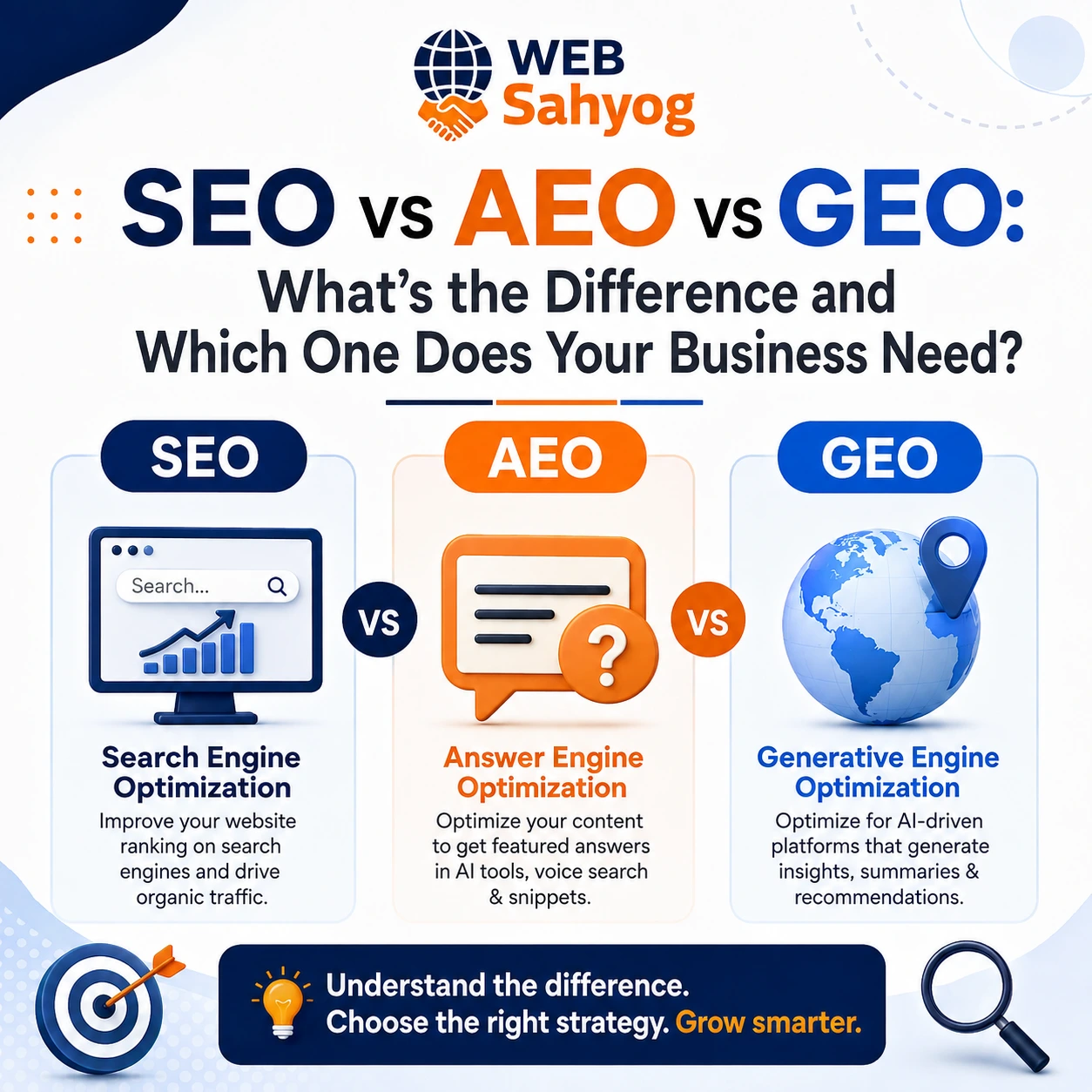
The simple answer is: SEO, AEO, and GEO have different goals, but they can work together. SEO helps your website become visible in search results. AEO helps your content provide direct answers. GEO helps make your information easier for generative AI systems to understand and use.
For businesses planning their digital growth, understanding these differences can help them spend their marketing budget more effectively.
Why Search Is Changing
The biggest change in search is not simply technology. It is how people find information.
A user might search Google for:
Another user may ask:
“What should I check before choosing a digital marketing agency?”
A third user may ask an AI search tool:
“Which digital marketing companies can help a small business improve local visibility?”
All three users may have a similar goal, but their search behavior is different.
This means businesses need content that can work across different search experiences.
According to Google’s Search Central guidance, Google’s systems are designed to prioritize helpful, reliable, people-first content rather than content created mainly to manipulate search rankings. That principle is important for SEO, AEO, and GEO alike.
What Is SEO?
SEO, or Search Engine Optimization, is the process of improving a website so search engines can understand its content and show relevant pages to users.
SEO is still the foundation of online visibility.
It includes areas such as:
- Keyword research
- Search intent
- On-page SEO
- Technical SEO
- Internal linking
- Content optimization
- Website performance
- Backlinks and authority
- Local SEO
For example, if a company provides marketing services in Jharkhand, its website should clearly explain its services, target locations, expertise, and customer problems.
Why SEO Still Matters
SEO helps businesses build long-term organic visibility.
A well-optimized website can attract people who are actively searching for:
- Products
- Services
- Solutions
- Information
- Local businesses
- Comparisons
SEO also supports AEO and GEO because search engines and AI systems need well-structured, understandable content before they can interpret and surface it effectively.
What Makes Modern SEO Different?
Old SEO often focused heavily on exact-match keywords.
Modern SEO is broader.
Google recommends creating content primarily to help people rather than producing content simply to gain search rankings.
Therefore, modern SEO should focus on:
Search intent + helpful content + technical quality + authority + user experience.
That is a much stronger approach than simply adding keywords to a page.
What Is AEO?
AEO, or Answer Engine Optimization, focuses on creating content that clearly answers the questions people ask.
Think about the difference between these two approaches.
Traditional content might target:
“Local SEO services”
AEO-focused content might answer:
“What do local SEO services actually include?”
The second approach directly matches a question a potential customer may have.
How Does AEO Work?
AEO content makes important information easy to find and understand.
Useful AEO formats include:
- Question-based headings
- Short direct answers
- FAQs
- Step-by-step guides
- Lists
- Definitions
- Comparison tables
- How-to sections
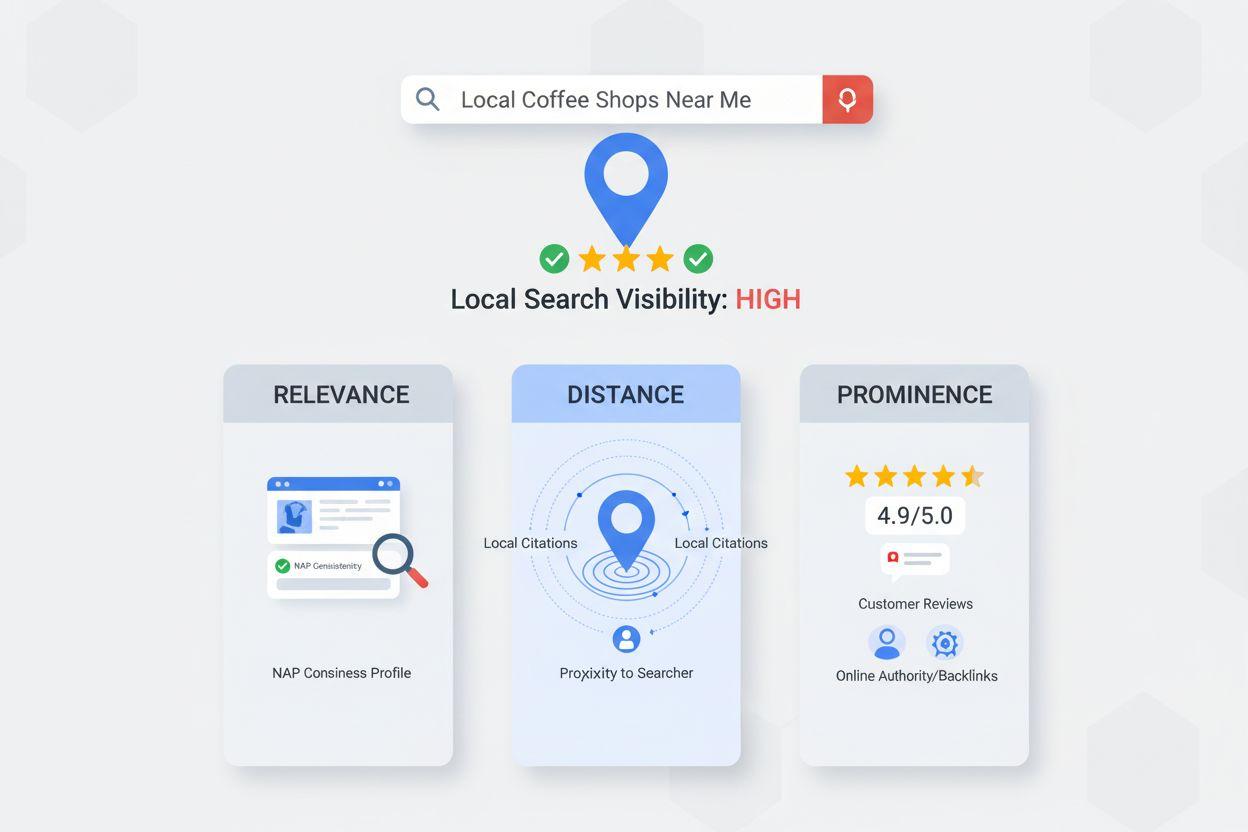
What Is Local SEO?
Local SEO is the process of improving a business’s online visibility for searches connected to a specific location. It can include Google Business Profile optimization, local content, reviews, location pages, citations, and other local search signals.
The answer is direct, but the article can then provide more detail.
Why Is AEO Important?
People increasingly search using complete questions instead of short keywords.
AEO helps businesses prepare content for these question-based searches.
It can be particularly useful for businesses with complex products or services because customers often need information before contacting a company.
For example:
- What does SEO cost?
- How long does SEO take?
- How does local SEO work?
- What is technical SEO?
- Should a small business invest in SEO?
- How can my website appear in AI search?
Answering these questions can make your website more useful and can also support visibility in search experiences that provide direct answers.
What Is GEO?
GEO, or Generative Engine Optimization, focuses on making a brand’s information clear, useful, trustworthy, and easy for generative AI systems to understand.
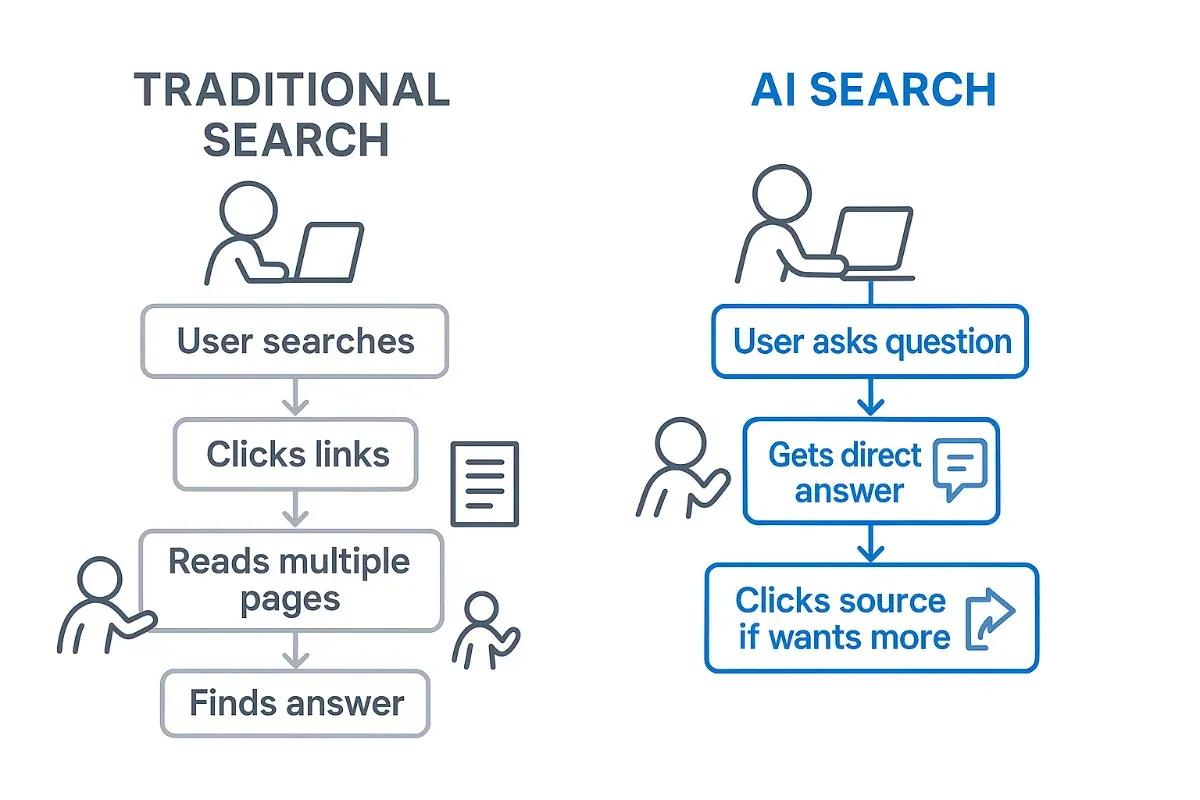
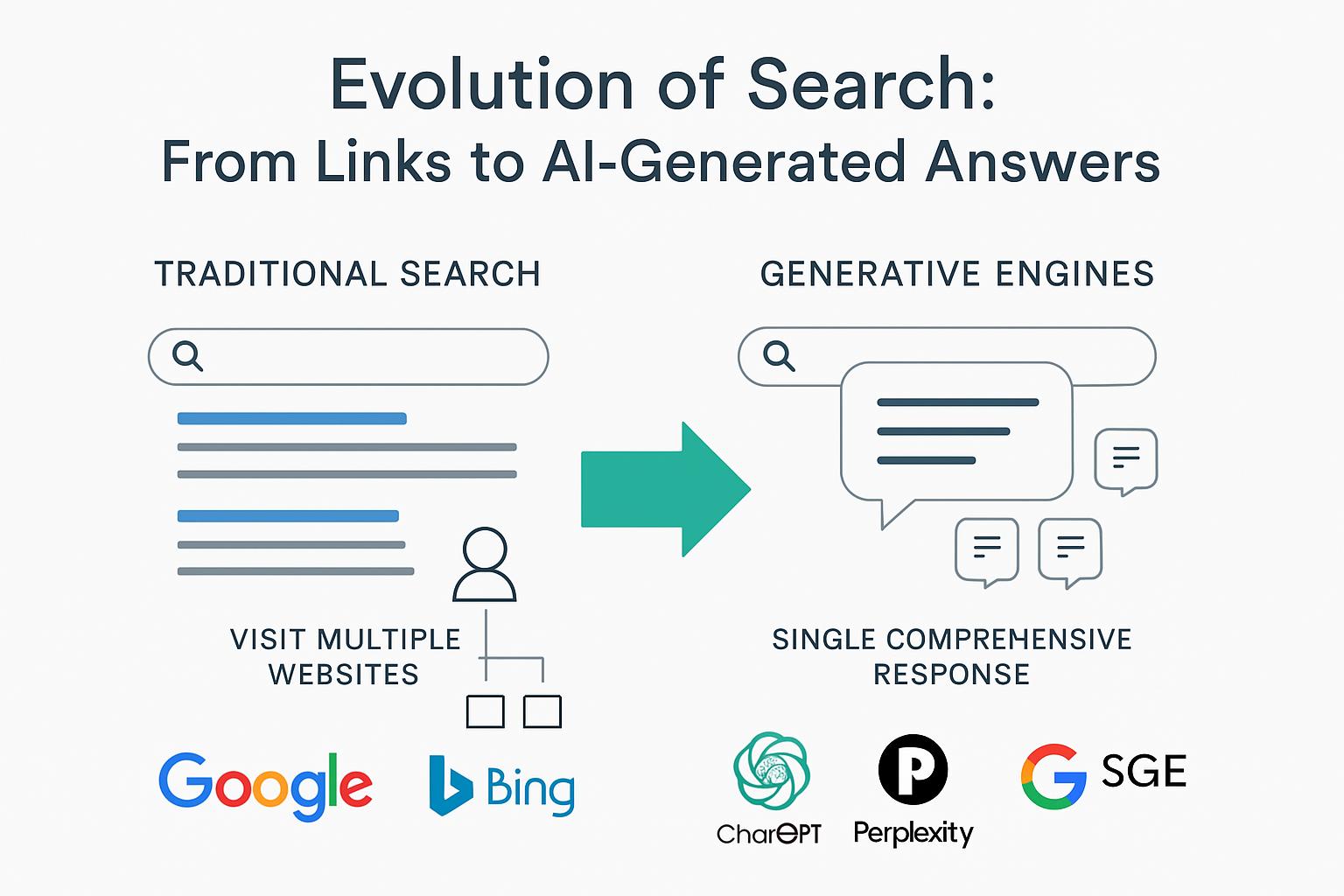
Generative AI search is different from traditional search.
Instead of simply presenting ten blue links, an AI-powered search experience may summarize information from different sources and provide a conversational response.
This changes what businesses need to think about.
The question is no longer only:
“Can my website rank?”
Businesses should also think:
“Is my brand information clear and trustworthy enough to be understood when AI systems answer questions about my industry?”
How Does GEO Work?
There is no guaranteed formula for getting mentioned in AI-generated answers.
However, businesses can improve the quality and clarity of their digital information by focusing on:
- Helpful original content
- Clear explanations
- Strong topical coverage
- Consistent business information
- Relevant entities and concepts
- Author expertise
- Trustworthy sources
- Strong internal linking
- Useful examples
- Clear answers to customer questions
GEO should therefore be treated as an extension of a strong content and search strategy—not as a shortcut.
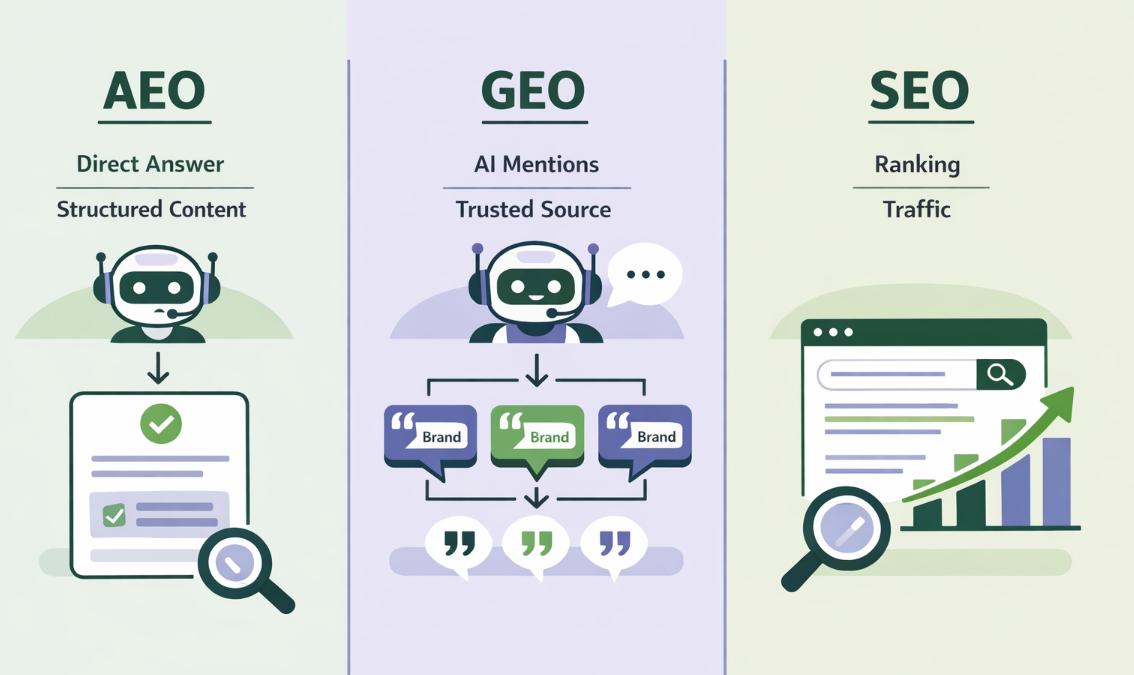
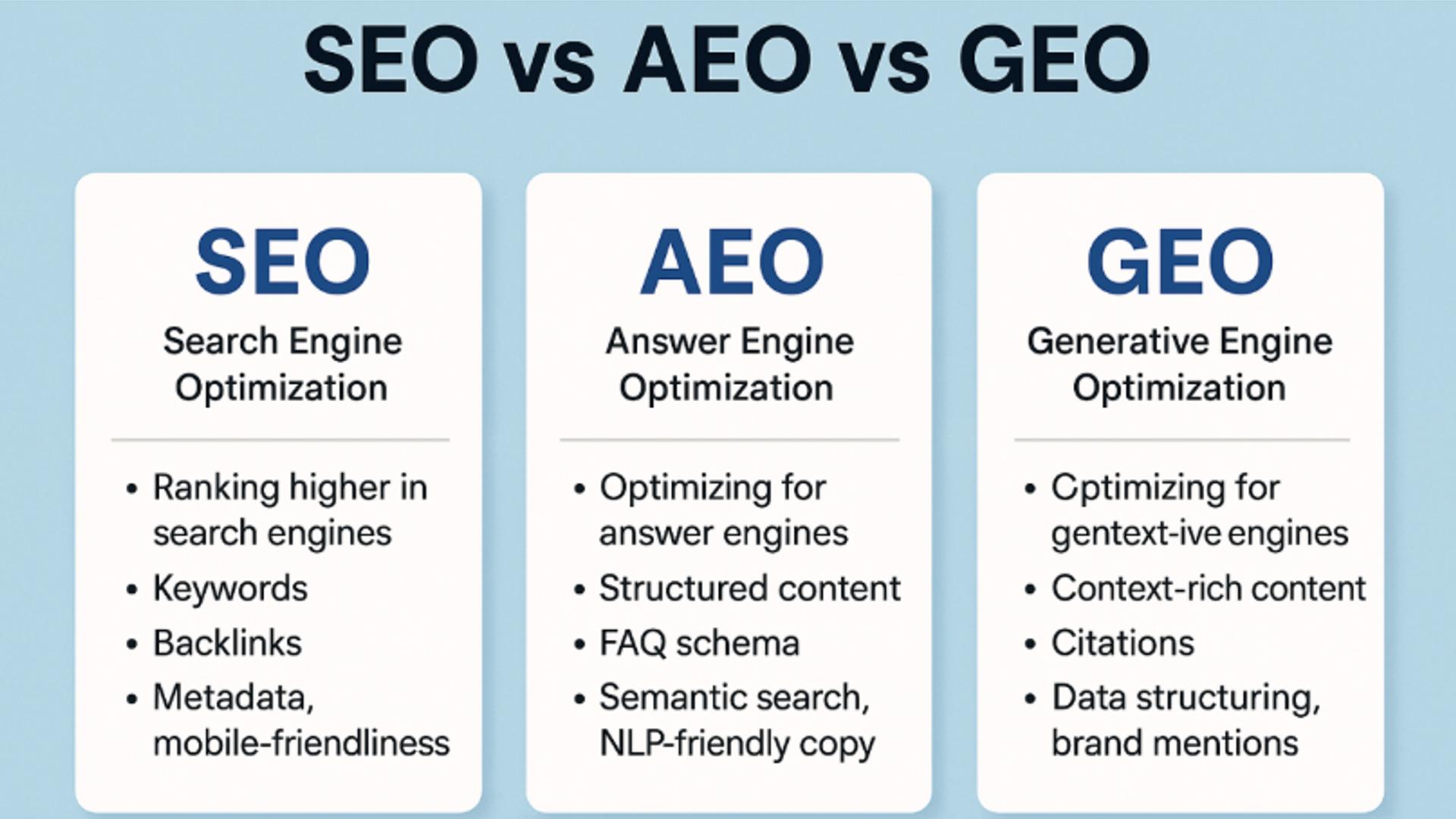
SEO vs AEO vs GEO: What Is the Difference?
The easiest way to understand the three approaches is to look at their primary goals.
| Factor | SEO | AEO | GEO |
|---|---|---|---|
| Main goal | Improve search visibility | Provide direct answers | Improve visibility in generative search |
| Main focus | Website and content optimization | Questions and answers | Context, usefulness and authority |
| Typical user action | Search and click | Ask and get an answer | Ask AI and explore |
| Useful content | Blogs, service pages, guides | FAQs, definitions, how-to content | Detailed, trustworthy, contextual content |
| Important signals | Relevance, technical SEO, links, content | Clear answers and structure | Expertise, context, entities, trust |
| Main opportunity | Organic search traffic | Answer visibility | AI-generated search visibility |
The important point is that SEO, AEO, and GEO are not three completely separate marketing activities.
A single high-quality article can support all three.
How SEO, AEO and GEO Work Together
Imagine a company wants to attract businesses looking for digital marketing support.
It can create one strong content ecosystem.
SEO: Optimize a service page for relevant commercial searches.
AEO: Add clear answers to questions such as “What does SEO include?” and “How long does SEO take?”
GEO: Provide detailed, trustworthy information about SEO, local search, content strategy, AI search, and related topics.
This creates a better experience for both users and search systems.
A useful way to remember the difference is:
SEO helps people find you.
AEO helps people get answers from you.
GEO helps AI systems understand and potentially surface your information.
Which Strategy Does Your Business Need?
The right answer depends on your business model.
If You Are a Local Business
Local businesses should usually start with strong SEO and local search optimization.
This includes:
- Google Business Profile
- Local keywords
- Location pages
- Reviews
- Local content
- Consistent business details
- Relevant citations
- Service pages
For example, businesses searching for local seo optimisation services should look for a strategy that covers both website visibility and local search presence.
7 Practical Ways to Optimize for SEO, AEO and GEO
1. Understand What Your Customer Wants
Before creating content, identify the search intent.
Ask:
- What problem is the user trying to solve?
- Are they looking for information or a service?
- What questions will they ask next?
- What might stop them from making a decision?
This creates better content than simply selecting high-volume keywords.
2. Create Direct Answers
For important questions, answer immediately.
Then provide supporting details.
This makes the content easier to scan and understand.
3. Build Topic Clusters
Don’t publish random articles.
Create groups of related content around important topics.
For example, a digital marketing website can build connected resources around:
- SEO
- Local SEO
- Technical SEO
- Content marketing
- AEO
- GEO
- Google Business Profile
- Digital advertising
This gives users a deeper resource and helps establish topical relevance.
4. Improve Local Search Signals
If you serve a specific region, clearly communicate it.
For example, a business targeting Jharkhand should make its service areas and business information easy to understand.
A company looking for a digital marketing agency in Jharkhand should not have to search through multiple pages to discover what services the company offers and where it operates.
5. Use Real Examples
Instead of only saying:
“Create helpful content.”
Explain what helpful content looks like.
For example:
A weak article says:
“SEO is important for businesses.”
A stronger article explains:
“SEO can help a business attract people who are already searching for its products or services, reducing dependence on paid traffic over time.”
The second version gives the reader a clear reason and outcome.
6. Build Trust
AI systems and search engines need reliable information.
Businesses should:
- Explain who created the content.
- Demonstrate industry knowledge.
- Support important factual claims.
- Keep information updated.
- Avoid misleading statements.
- Provide accurate business information.
7. Measure Business Outcomes
Don’t measure SEO success only through rankings.
Track:
- Organic clicks
- Impressions
- CTR
- Leads
- Conversions
- Local visibility
- Engagement
- Branded searches
- Top-performing content
The final goal is not simply a ranking.
The goal is qualified visibility that contributes to business growth.
SEO, AEO and GEO Mistakes to Avoid
Businesses often make the same mistakes when adapting to modern search.
Keyword Stuffing
Repeating the same keyword again and again does not automatically improve visibility.
Thin Content
A 1,000-word article is not automatically better than a 500-word article.
Useful information matters more than word count.
Generic AI Content
AI can help with research and drafting, but publishing generic content without expertise, editing, examples, or original value can make the article less useful.
Ignoring Local Search
A business serving one city or state should not rely only on broad national keywords.
Writing Only for Search Engines
If a human reader cannot understand or use your content, optimization has missed the point.
Making Unsupported Claims
Avoid statements such as “GEO guarantees AI rankings” or “AEO guarantees featured snippets.”
No legitimate optimization strategy can guarantee a particular search result.
Frequently Asked Questions
Yes. SEO remains an important foundation for online visibility. AI search does not remove the need for a technically strong website, useful content, relevant information, and trustworthy signals. Businesses should improve traditional search visibility while also making their content easy to understand and useful for question-based and generative search experiences.
No. AEO is better understood as a complementary approach. SEO focuses on broad search visibility, while AEO focuses on answering user questions clearly. A good SEO strategy can include AEO techniques such as FAQs, direct answers, structured content, question-based headings, and helpful how-to sections.
No. There is no guaranteed method for controlling AI-generated results. GEO focuses on making information clear, authoritative, relevant, and easy for generative systems to understand. Businesses should concentrate on strong content, accurate information, expertise, topical depth, and trustworthy digital signals.
A local business should generally build a strong SEO and local search foundation first. AEO can help answer customer questions, while GEO can support visibility as AI search becomes more common. The best strategy depends on the business, audience, location, competition, and customer search behavior.
Professional support can be useful when SEO requires technical work, content planning, local optimization, competitive research, and ongoing measurement. Businesses should evaluate an agency based on its strategy, transparency, experience, reporting, and ability to connect search activity with business goals—not simply promises of guaranteed rankings.
Optimizing a Google Business Profile, collecting customer reviews, creating location-specific pages, and investing in local seo optimisation services can significantly improve local visibility.
Conclusion: Don't Choose One—Build a Smarter Search Strategy
The future of search is not simply about getting a website onto the first page of Google.
People want quick answers. They use different search platforms. They ask conversational questions. They compare businesses before making decisions. And increasingly, they use AI to research products, services, and solutions.
That is why businesses need to think beyond traditional optimization.
SEO creates the foundation for organic search visibility. AEO helps businesses answer important questions clearly. GEO prepares content for a search environment where generative AI can summarize and connect information.
The strongest approach is to combine them.
Start with technical SEO and search intent. Build genuinely helpful content. Answer real customer questions. Strengthen local visibility. Demonstrate expertise. Keep business information accurate and consistent. Then measure the results based on traffic, leads, conversions, and brand visibility.
For businesses looking for a best seo marketing company, the right partner should not focus only on keyword rankings. The strategy should consider how customers discover, evaluate, and trust your business across traditional search, local search, answer engines, and AI-powered search.
Web Sahyog can position its digital marketing strategy around this broader search ecosystem—helping businesses prepare not only for how people search today, but also for how they will discover information tomorrow.