

How to Use Email Marketing Services in Bokaro to Increase Sales
If you run a business in Bokaro, your marketing budget is probably already split between social media ads, a bit of local SEO, and word of mouth. Email rarely makes the list, usually because nobody has shown local businesses what Email Marketing Services In Bokaro actually look like when done properly. Done right, email remains one of the cheapest ways to turn a one-time buyer into a repeat customer — and for Bokaro’s steel-belt trading businesses, distributors, and service providers, that repeat-business angle matters more than chasing new followers.
This article covers why email gets overlooked locally, how to actually use it to drive sales, and what current data says about its return compared to other channels.
Why Bokaro Businesses Overlook Email Marketing
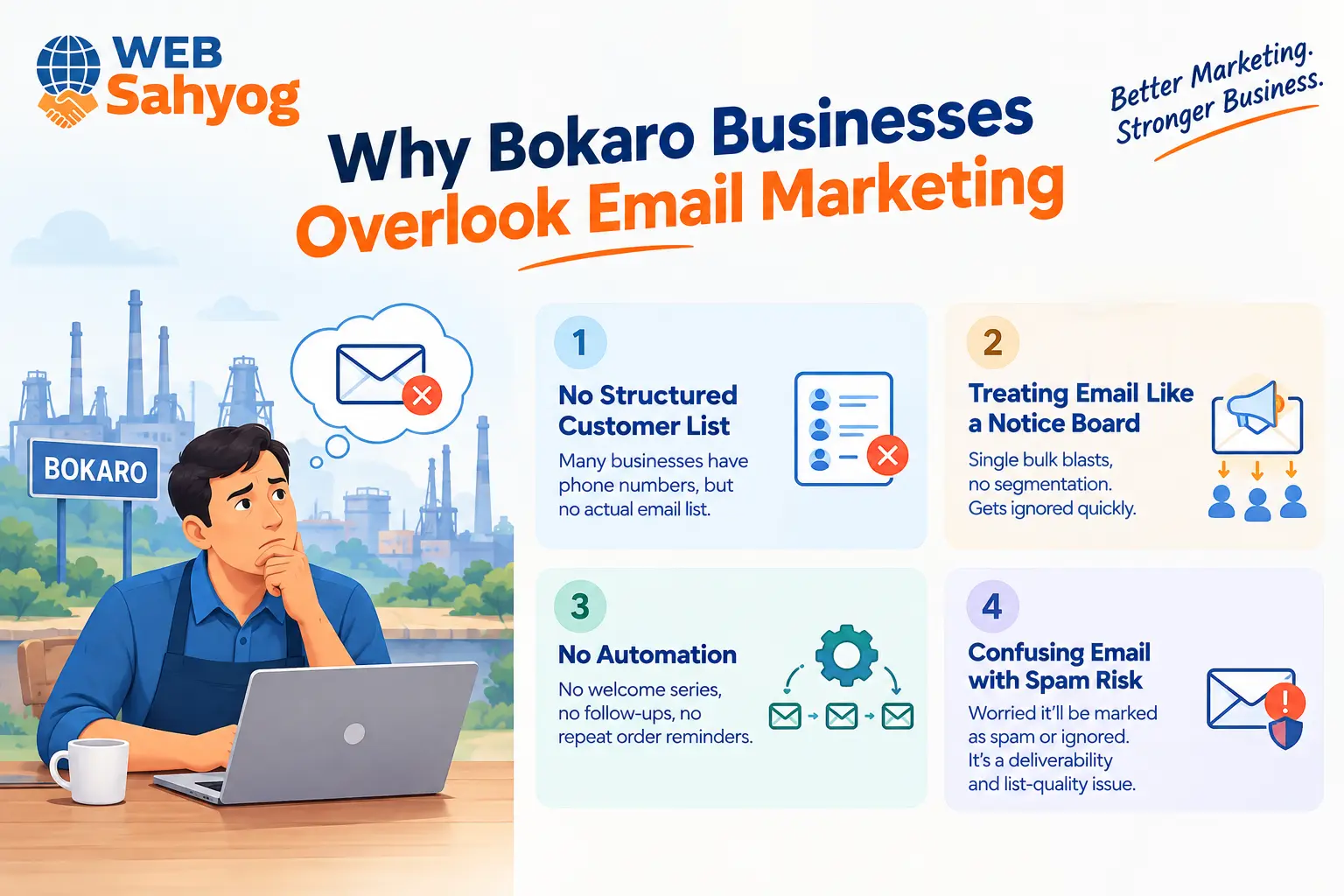
Bokaro’s economy runs heavily on steel, ancillary manufacturing, and B2B trading, alongside a growing retail and services sector — businesses with long sales cycles and repeat transactions, exactly where email should be strongest. Yet most local businesses either never adopted it or let it go stale, for a few recurring reasons.
No structured customer list. A shop or distributor might have hundreds of phone numbers saved across WhatsApp but no actual email list, because nobody ever asked for one at the point of sale. Without a list, there’s no channel to build.
Treating email like a notice board. When businesses do send emails, it’s often a single bulk blast — a festival discount or generic update — sent to everyone with no segmentation. This gets ignored quickly and trains recipients to stop opening future emails.
No automation. A customer who buys once rarely hears from the business again unless they happen to see a social post. There’s no welcome sequence, no follow-up after purchase, no reminder before a repeat order is due — all of which email handles automatically once set up.
Confusing email with spam risk. Some owners avoid email altogether, worried it’ll be marked as spam or ignored. This is usually a deliverability and list-quality problem, not a reason to skip the channel — and it’s fixable with the right setup.
5 Proven Ways to Use Email Marketing to Increase Sales
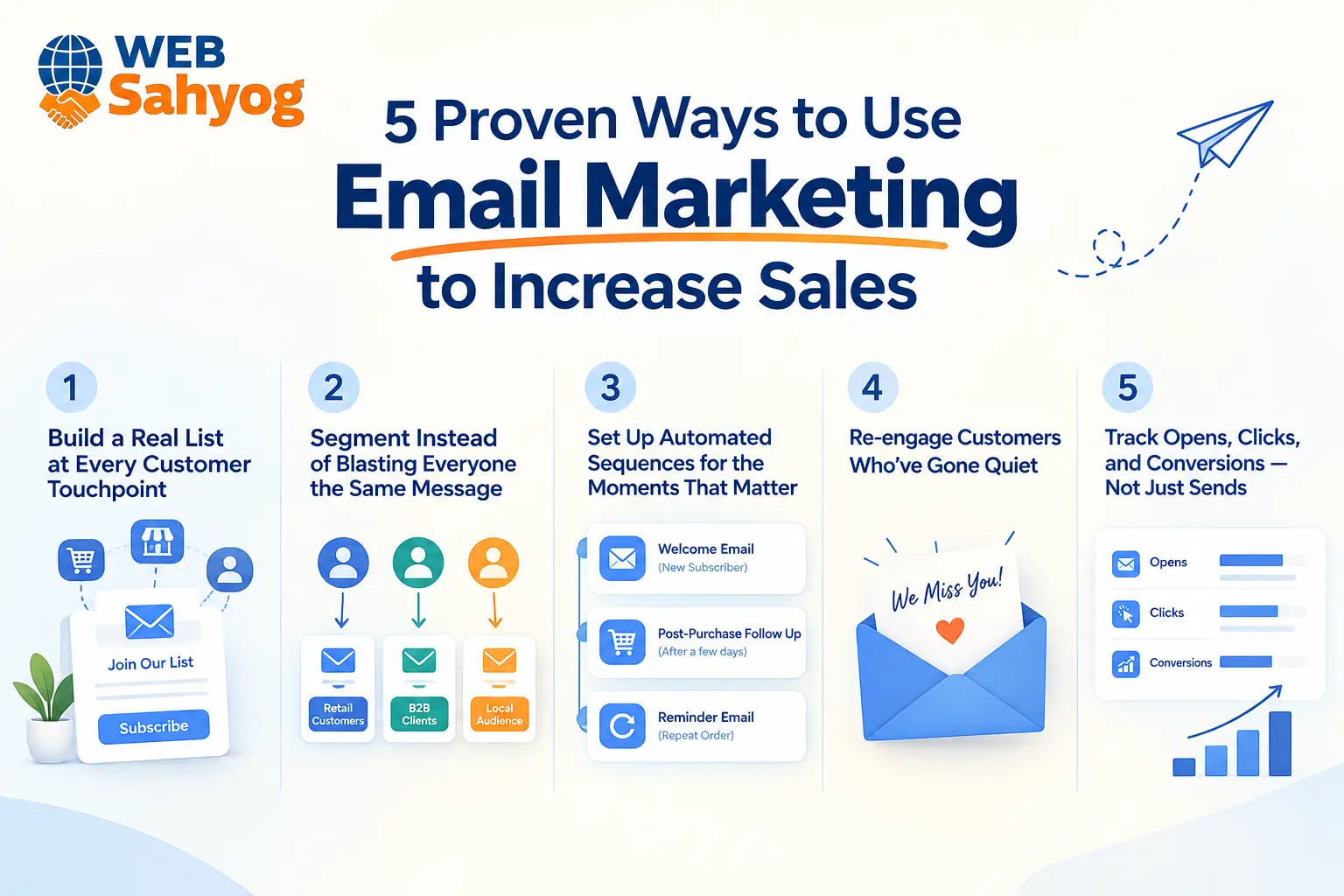
1. Build a Real List at Every Customer Touchpoint
The single biggest fix is collecting emails consistently — at checkout, through a sign-up form on your website or Google Business Profile, or as part of an invoice process for B2B clients. A list built this way is made of people who already have a relationship with the business, which is why email consistently outperforms cold outreach on conversion.
2. Segment Instead of Blasting Everyone the Same Message
Not every customer wants the same email. A distributor’s industrial-equipment buyers and a retail customer’s festive-offer audience need different messaging. Segmenting by purchase history, location, or customer type means each email is relevant enough to actually get opened and acted on, instead of being one more message that gets deleted on sight.
3. Set Up Automated Sequences for the Moments That Matter
A welcome email when someone first signs up, a follow-up a few days after a purchase, and a reminder when a repeat order is typically due — these can all run automatically once set up. This is where email earns its reputation for efficiency: the sequence works in the background without anyone manually sending each message.
4. Use Email to Re-engage Customers Who’ve Gone Quiet
Most businesses lose customers slowly, not all at once. A simple “we haven’t seen you in a while” email with a relevant offer can bring back a portion of customers who would otherwise never return, and it costs far less than acquiring a new customer through paid ads.
5. Track Opens, Clicks, and Conversions — Not Just Sends
Sending an email isn’t the goal; getting someone to act on it is. Reviewing which subject lines get opened and which links get clicked lets a business refine future emails instead of guessing. Without this step, it’s impossible to know whether email is actually contributing to sales or just adding to inbox clutter.
What the Data Says About Email Marketing's Return
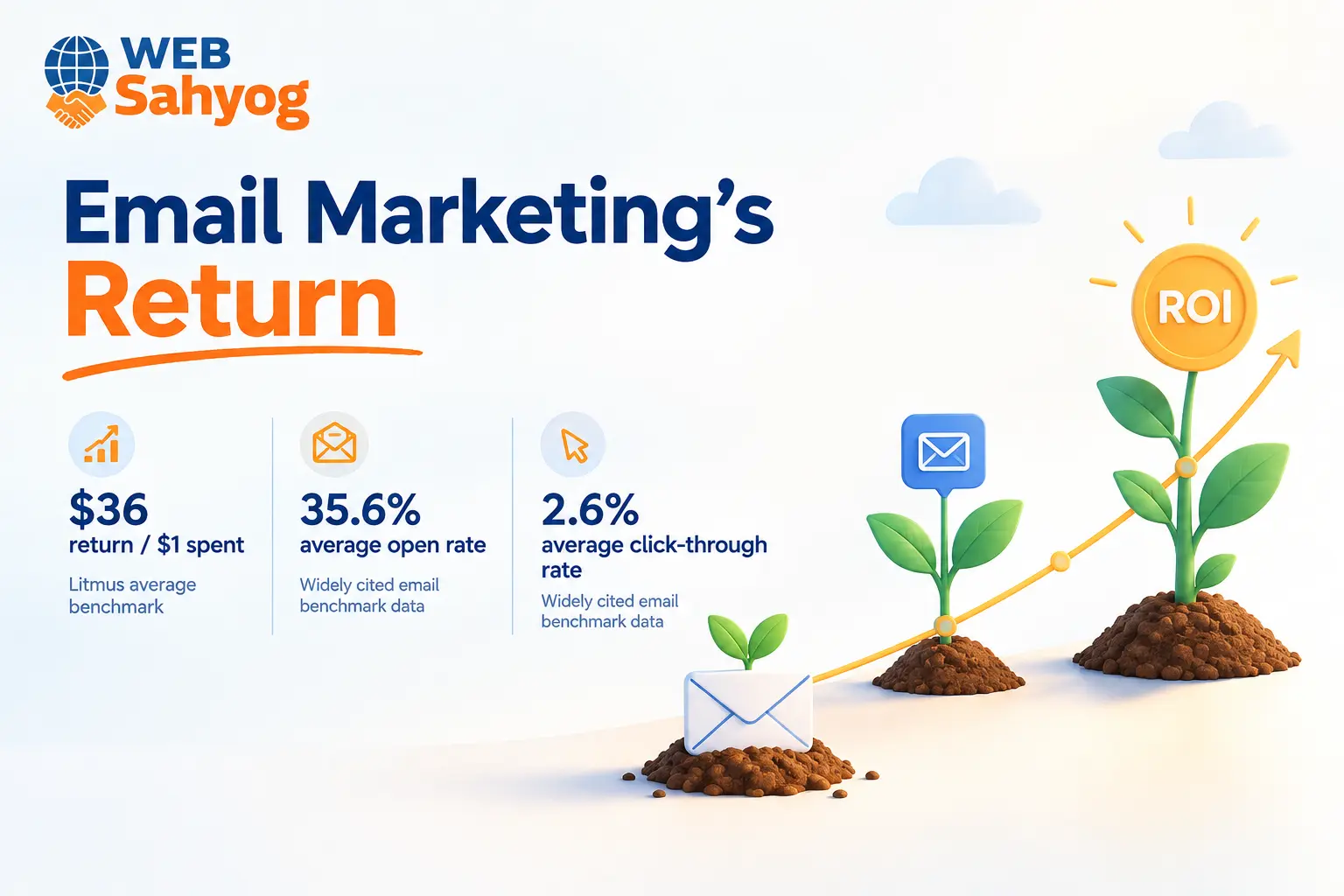
Email marketing’s reputation for strong returns isn’t just a sales pitch — it holds up in both global and India-specific data. According to Litmus, a widely cited Email platform benchmark, email delivers roughly $36 in return for every $1 spent, consistently outpacing most paid social and display advertising.
India’s own email advertising spend is still comparatively modest — Statista projects it will reach about $236.79 million in 2025, growing at a CAGR of around 2.98% to touch $274.24 million by 2030. That slower growth, compared to the surge in social ad spend, works in a local business’s favor: fewer competitors use email well, so a solid campaign faces less inbox competition than a social ad competing for attention in a crowded feed.
On engagement, benchmarks compiled by G2 put the average email open rate across industries at around 35.6%, with click-through rates typically landing between 2.5% and 3%. These vary by sector and list quality, but they confirm a well-maintained list still reaches a meaningful share of recipients — something cold social reach increasingly struggles to do without paid boosts.
Where This Is Headed
These are reasonable extrapolations, not guarantees. As more Indian businesses adopt CRM tools that connect email to purchase history, personalization is likely to become the norm rather than a differentiator. Automation platforms are also becoming more affordable for small businesses, which should make the sequence-based approach described above accessible without a full-time marketing hire.
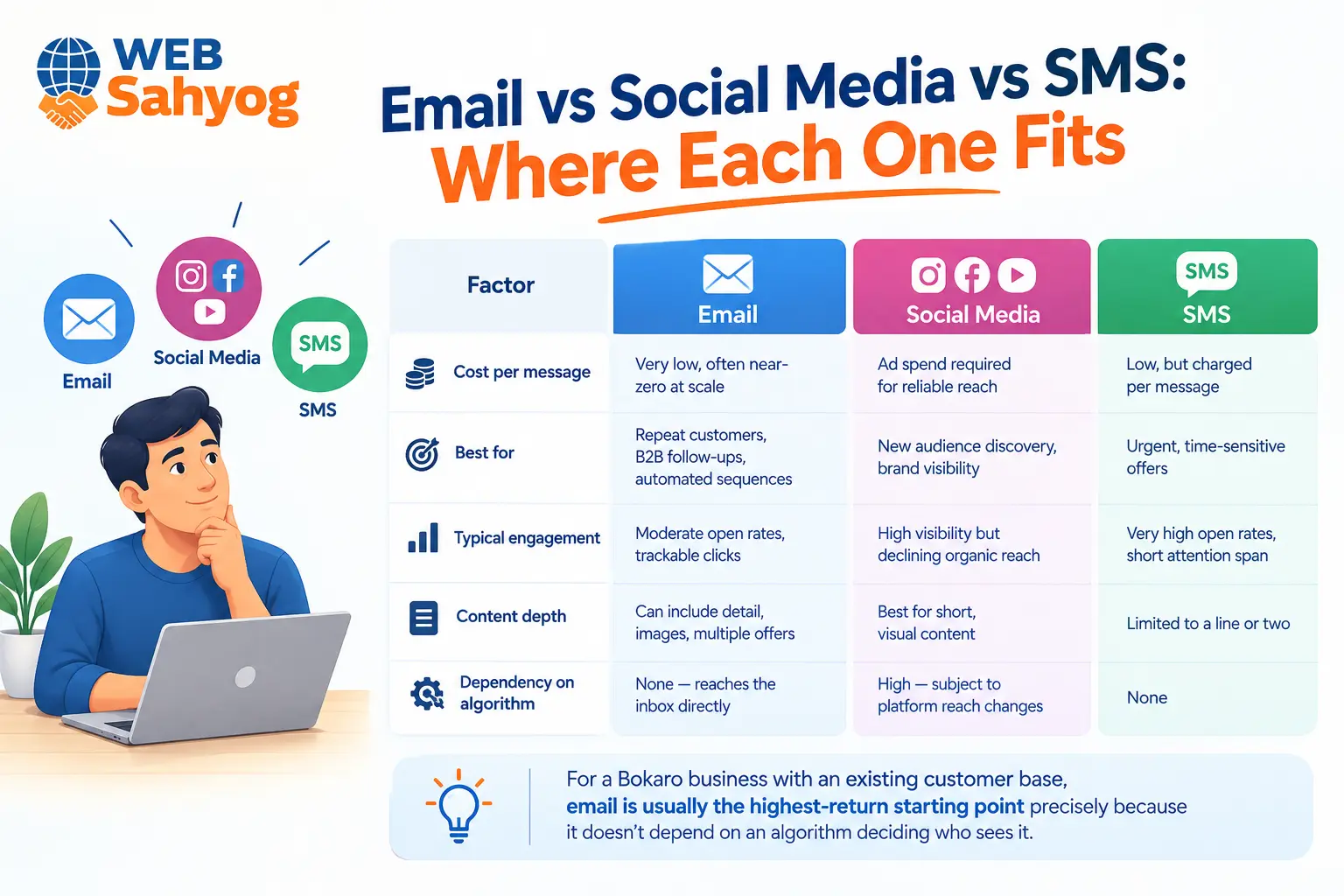
Email vs Social Media vs SMS: Where Each One Fits
Choosing a single channel isn’t usually the right move — but understanding what each does best helps decide where to put the first rupee.
| Factor | Social Media | SMS | |
|---|---|---|---|
| Cost per message | Very low, often near-zero at scale | Ad spend required for reliable reach | Low, but charged per message |
| Best for | Repeat customers, B2B follow-ups, automated sequences | New audience discovery, brand visibility | Urgent, time-sensitive offers |
| Typical engagement | Moderate open rates, trackable clicks | High visibility but declining organic reach | Very high open rates, short attention span |
| Content depth | Can include detail, images, multiple offers | Best for short, visual content | Limited to a line or two |
| Dependency on algorithm | None — reaches the inbox directly | High — subject to platform reach changes | None |
For a Bokaro business with an existing customer base, email is usually the highest-return starting point precisely because it doesn’t depend on an algorithm deciding who sees it.
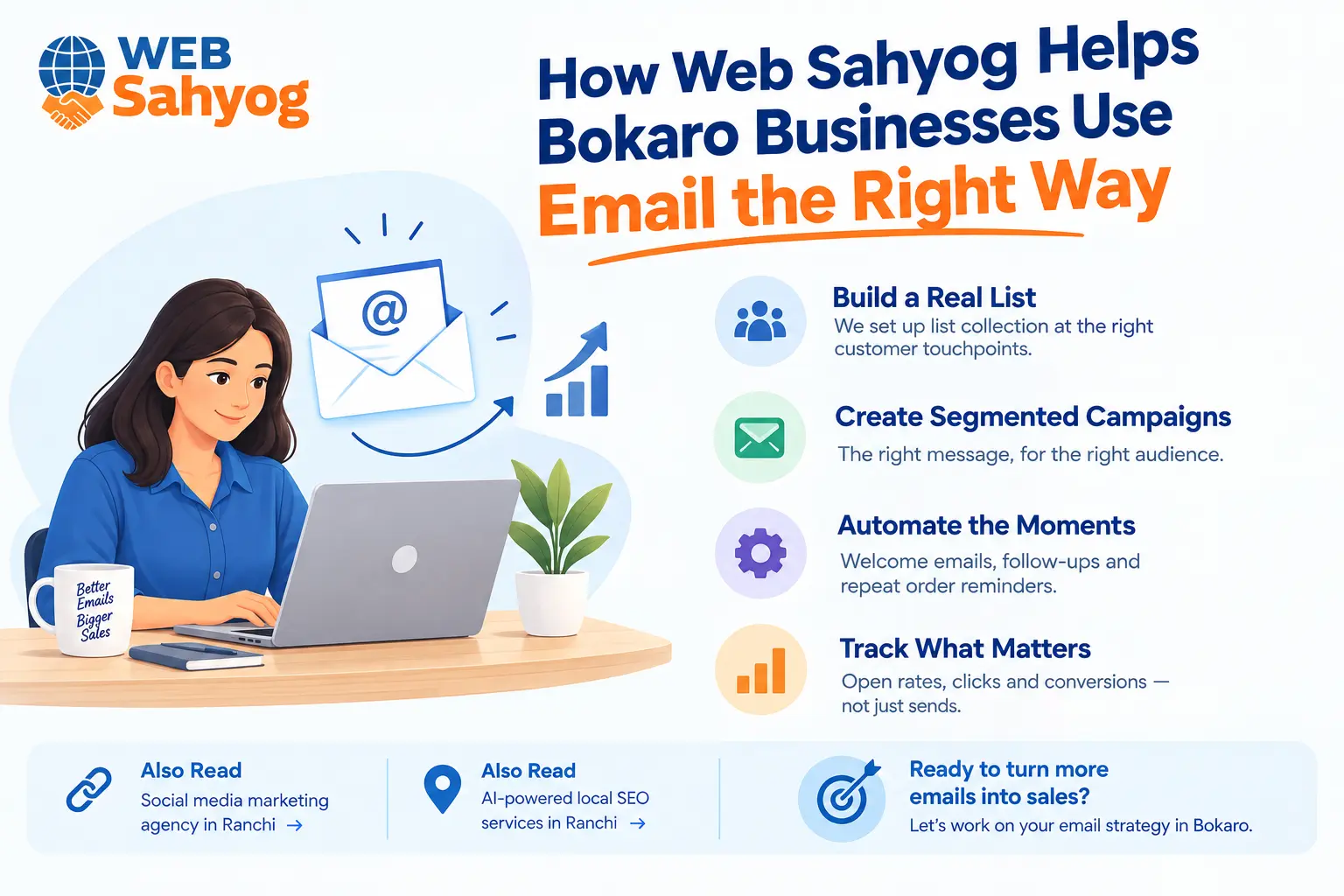
How Web Sahyog Helps Bokaro Businesses Use Email the Right Way
Businesses that come to us for email marketing services in Bokaro usually have one of two problems: they’ve never built a real list, or they built one and let it go stale with no automation. We start by setting up proper list collection at the points where customers already interact with the business, then build segmented campaigns and automated sequences around the moments that actually drive repeat sales.
Email rarely works best in isolation. If you’re also active on Instagram or Facebook, our guide on social media marketing agency in Ranchi covers how the two channels reinforce each other rather than compete for the same budget. And if local discovery is part of your growth plan, our piece on AI-powered local SEO services in Ranchi explains how search visibility and email list-building work together.
As an email marketing agency in Bokaro focused on measurable follow-through rather than one-off blasts, our aim is simple: fewer wasted sends, more emails that lead to a sale. If you’re weighing us as the best digital marketing agency in Bokaro, we’re glad to review your current list and show where the easiest wins are.
Frequently Asked Questions
Yes. Industry data continues to show a strong return relative to other channels, largely because email reaches an inbox directly rather than depending on an algorithm. For businesses with an existing customer base, it remains one of the most cost-effective ways to drive repeat sales.
Start by collecting emails at natural touchpoints — checkout, invoicing, your website, or your Google Business Profile — rather than buying a list, which usually results in poor deliverability and low engagement. Even a small, genuinely interested list of 200–300 contacts can outperform a large purchased one.
Industry benchmarks put average open rates around 30–36% across sectors, though this varies by industry and list quality. A well-segmented list with relevant subject lines can perform meaningfully above average.
This depends on the business, but a common starting point is one to two emails per month for general updates, supplemented by automated emails triggered by customer actions like a purchase or sign-up. Sending too frequently without relevant content is the fastest way to increase unsubscribes.
They work best together. Social media is strong for reaching new audiences, while email is stronger for converting and retaining people who already know the business, so most Bokaro businesses see the best results running both rather than picking one.
Conclusion
Email Marketing Services In Bokaro works for Bokaro businesses the same way it works everywhere else: by reaching people who already have a relationship with the business, without depending on an algorithm’s mood that day. A real list, relevant segmentation, and a few automated sequences are usually enough to turn email from an ignored channel into a steady source of repeat sales.